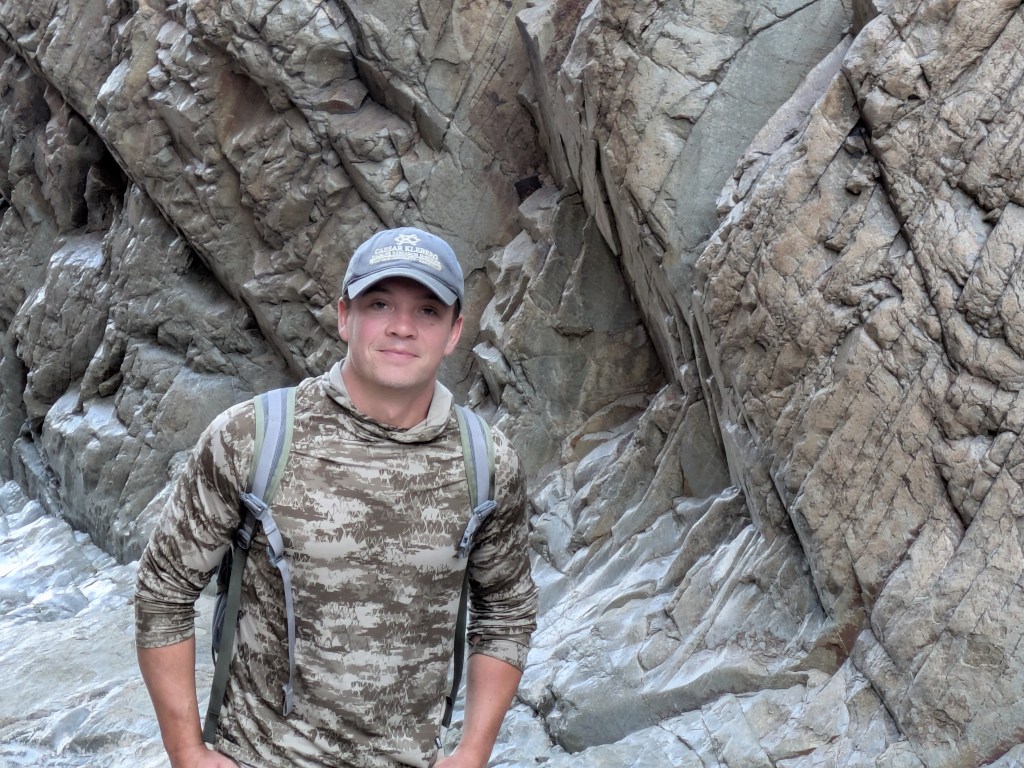
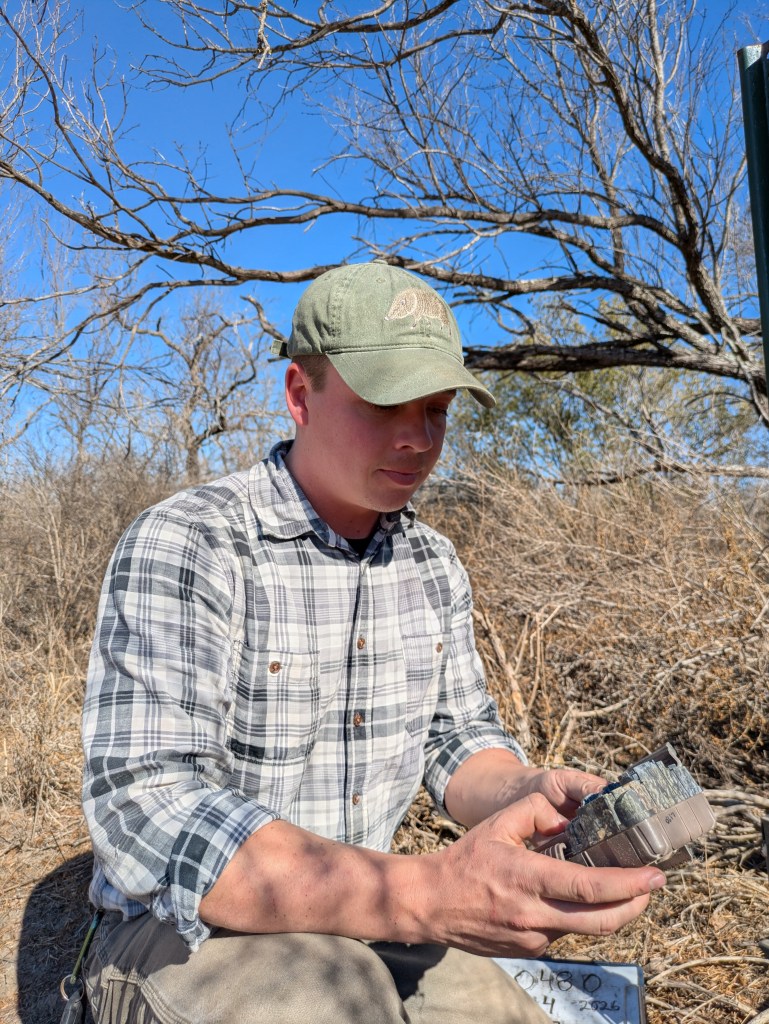
Ray is a Master’s student in the Cesar Kleberg Wildlife Research Institute at Texas A&M – Kingsville.
Originally from California, he earned his Bachelor’s degree in Wildlife Management and Conservation
from California Polytechnic University – Humboldt. Ray’s professional background spans several diverse
field projects, including duck banding in Nevada, elk monitoring and collaring in Northern California, and
Humboldt marten hair snaring in Southern Oregon. Most recently, he conducted camera trapping and
collaring of ocelots in South Texas. His current research focuses on mountain lions, reflecting a broad
interest in the coexistence of human and wildlife needs. Outside of his research, Ray is an avid
fisherman, hiker, and birder who also plays the trumpet.
Texas A&M University-Kingsville
Major-Advisor: Lisanne Petreacca, Ph.D.
Impacts of Linear Infrastructure on Mammal Communities in South Texas and Potential Mitigation Strategies
The ability to move freely through a landscape is essential to the persistence of wildlife species, yet
landscapes are increasingly fragmented by linear infrastructure. Fences represent the most widespread
and rapidly expanding barrier systems globally; however, the extent of their ecological impacts is poorly
understood. Thus far, most research on these impacts has employed a single-species approach, with
scarce research on community-level effects. A better understanding of the community-level effects of
linear infrastructure on wildlife, as well as how to mitigate their negative impacts to at-risk species,
should be a priority as linear infrastructure expands.
In South Texas, the expansion of the USA-Mexico border barrier and high fences on private ranchlands
presents significant challenges for wide-ranging mammals, particularly the mountain lion (Puma
concolor), due to their large home range requirements and genetic isolation from an obvious source
population. I plan to evaluate the impact of these barriers on mountain lions and the greater mammal
community, as well as test novel mitigation strategies to promote habitat connectivity.
To evaluate the impact of the border barrier, I am monitoring small wildlife passages (8”x11” sections
cut from the barrier’s base), barrier section ends, and water gates on creek beds using 75 camera trap
sites along approximately 28 miles of barrier. In addition, I will be using a combination of visual,
auditory, and olfactory attractants to increase the discoverability of small wildlife passages by mountain
lions. I will be characterizing the behaviors of mammals pre- and post- attractant placement to
determine the effect on the larger mammal community. To evaluate the impact of high fencing on
mountain lions, I am currently monitoring the movements 7 mountain lions fitted with GPS collars, with
continued efforts to collar more lions through May 2026.
 welderwildlife.org