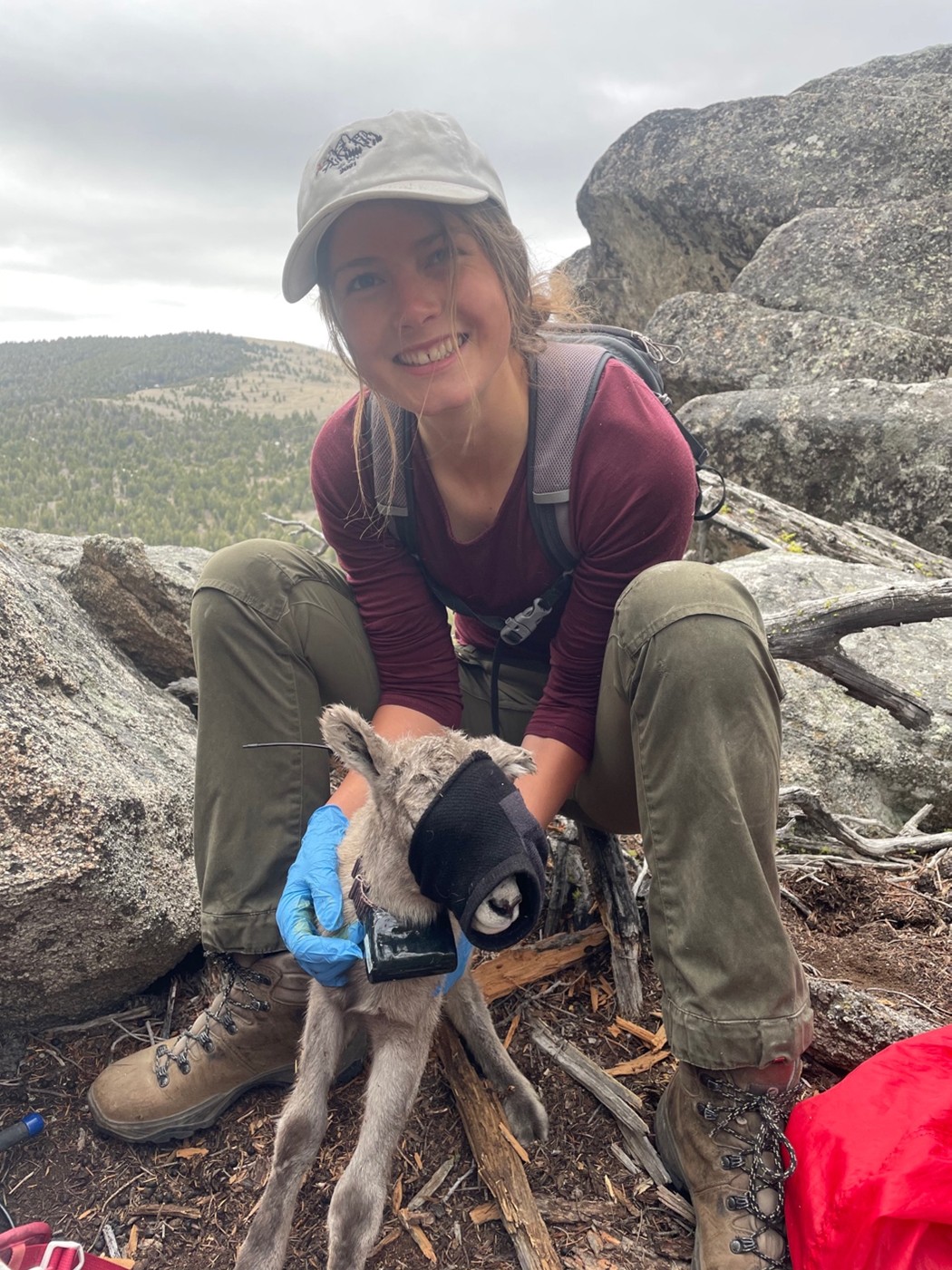
Elle is a graduate student at the Borderlands Research Institute with Sul Ross State University, where she is studying niche plasticity in desert bighorn sheep across the Trans-Pecos region of Texas. Originally from northern Idaho, her love for the outdoors was shaped by a childhood spent hunting, fishing, and backpacking. Elle earned her bachelor’s degree in Wildlife Management from the University of Idaho, where she gained hands-on experience through field technician roles in forestry, fisheries, range, and wildlife projects. After graduation, she worked on bighorn sheep research in Montana and Wyoming, sparking a lasting enthusiasm for the species. She is passionate about using scientific research to help inform wildlife management strategies and promote conservation. In her free time, Elle enjoys hiking, reading, and exploring new landscapes.

Sul Ross State University
Major Advisor: Justin T. French, Ph.D.
Niche Plasticity of Desert Bighorn Sheep in the Trans-Pecos, Texas
In Trans-Pecos, Texas, desert bighorn sheep (Ovis canadensis) were extirpated by the 1960s. However, restoration efforts have shown signs of success. Management of desert bighorn populations of the Trans-Pecos region is particularly complex as they co-occur with invasive aoudad (Ammotragus lervia), which not only carry and transmit diseases to desert bighorn but also occupy similar terrain. Previous research has demonstrated that aoudad and desert bighorn niches overlap in optimal habitat. This is particularly relevant due to recent die-offs of desert bighorn populations in the Trans-Pecos following disease outbreaks. These die-offs raise concern about spatial overlap between species increasing risk of disease transmission. Additionally, spatial overlap indicates potential for competition, which could result in changing strategies as desert bighorn seek to avoid competition with aoudad. It is essential to understand how desert bighorn niches may shift in the face of competition, particularly as we seek to manage populations in a disease landscape. I am exploring variation in niche breadth and position among populations in the Trans-Pecos to determine whether desert bighorn exhibit niche plasticity. Specifically, I will use integrated step selection analyses to model inter-individual habitat selection behavior and assess the niche of populations. To accomplish this, I will utilize 21 population years of movement data from 7 desert bighorn populations. I will also use mortality data to investigate how niche partitioning strategies impact survival. By focusing on potential competition-induced niche shifts, I intend to lay the groundwork for future targeted management actions for desert bighorn in landscapes co-occupied by aoudad.
 welderwildlife.org