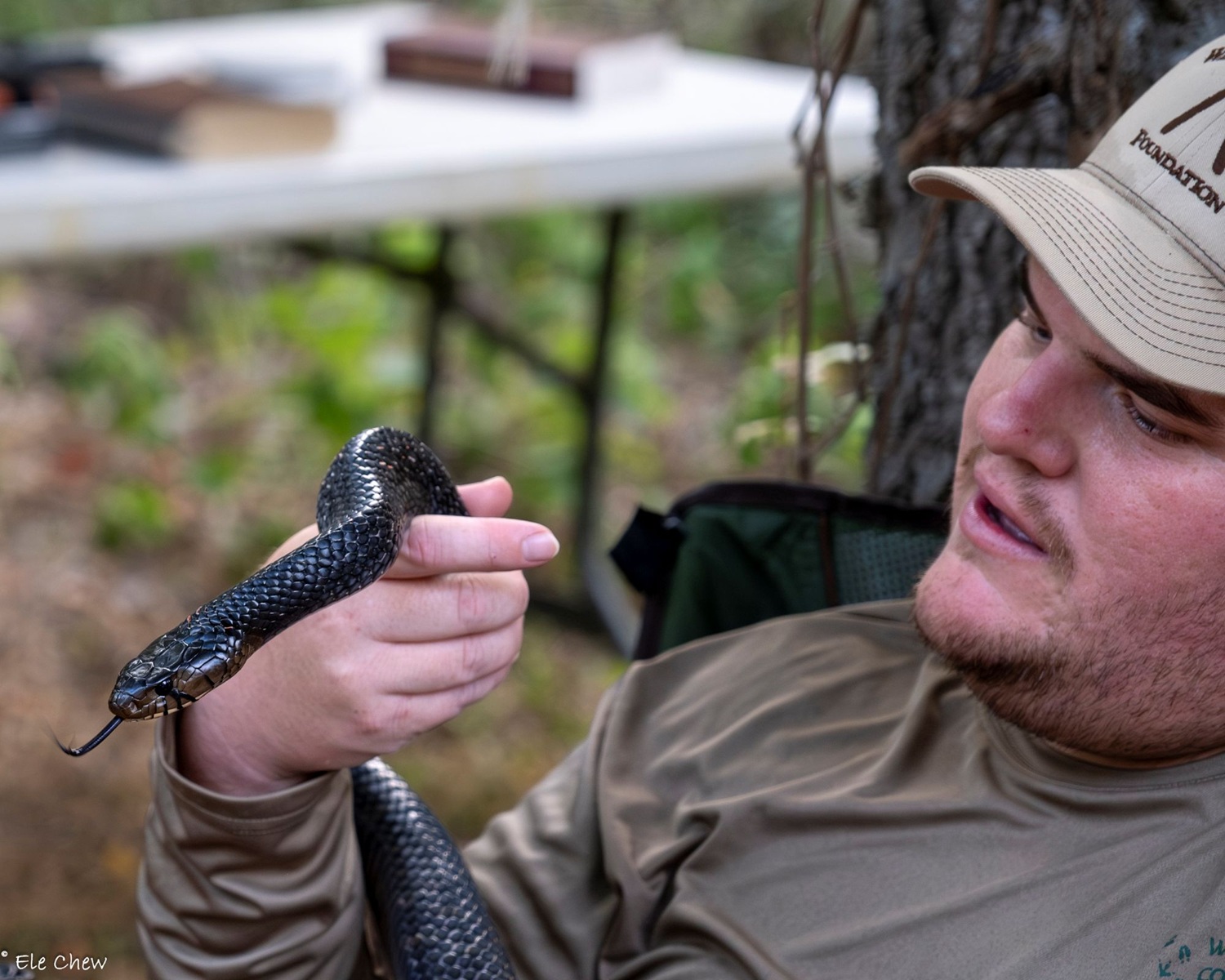
Duston is a doctoral student with Caesar Kleberg Wildlife Research Institute in the Department of Rangeland and Wildlife Sciences at Texas A&M University-Kingsville. He is co-advised by Dr. Scott Henke and Dr. Cord Eversole (Stephen F. Austin State University). Duston’s doctoral research focuses on evaluating the impacts of nonnative and invasive plants on herpetofauna and mammal communities. This project is a continuation of former Welder Fellow Andrew Mullaney’s masters research at Texas A&M International University. Duston is from Daviston, Alabama and grew up on a small family farm. He completed a Bachelor of Science in Wildlife Ecology and Management at Auburn University and a Master of Science in Wildlife, Fisheries, and Aquaculture at Mississippi State University. Duston’s research interests include the conservation and management of threatened and endangered species and wildlife communities with a focus on private land stewardship. Duston plans to continue his career in academia and conduct research that aids wildlife conservation by bringing together private landowners and state and federal agencies. During his free time, Duston enjoys being outdoors (hiking, herping, birding, hunting, fishing, etc.) or relaxing indoors watching TV or gaming.

Texas A&M University – Kingsville
Co-Advisor: Cord B. Eversole, Ph.D.
Co-Adivsor: Scott E. Henke, Ph.D.
INVASIVE VEGETATION IMPACTS ON HERPETOFAUNA AND MAMMAL POPULATIONS AND COMMUNITIES
Nonnative and invasive plants are considered a conservation threat to native ecosystems. As ecosystems are invaded, invasive plants can replace native plant species, resulting in changes in the vegetative structure and biodiversity of an area. The objectives of our study are to determine if vegetative invasions and subsequent changes in vegetation structure influence community composition, species abundance, and habitat associations of herpetofauna and mammals. To meet these objectives, we surveyed the herpetofauna and mammal communities at the Welder Wildlife Refuge. We surveyed herpetofauna and small mammal communities at six plots at varying levels of plant invasion. Additionally, we established 24 remote camera stations across the Refuge to monitor medium and large-sized mammal communities. We completed fieldwork in August 2024. We documented 31 reptile species, 12 amphibian species, and 11 small mammal species in our six survey plots. Our remote cameras have detected 21 mammal species, including the plains spotted skunk (Spilogale interrupta), a species of conservation concern. From our preliminary results monitoring small mammal and herpetofauna communities, we learned that habitat specialists are more likely to be negatively impacted by plant invasion, whereas generalist species are either unaffected or increased in abundance at sites with high densities of invasive plants. We expect medium and large-sized mammals to similarly respond to increasing density of invasive plants because plant invasion alters habitat availability, which affects specialist species and prey availability. Our study will provide information on managing invasive vegetation to maintain animal populations, species diversity, community composition, and ecological function.
 welderwildlife.org